Xinhua
01 Apr 2026, 15:45 GMT+10
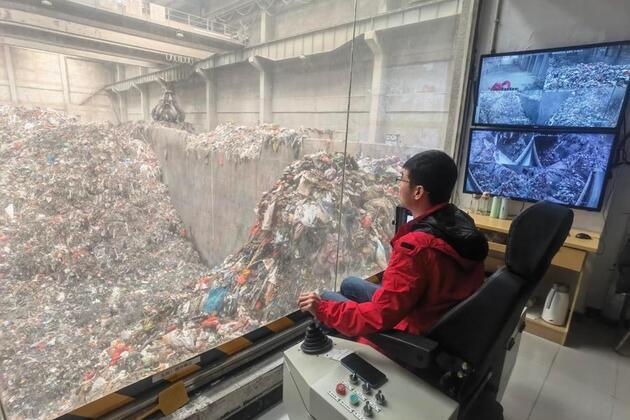
NANCHANG, April 1 (Xinhua) -- A modern domestic waste incineration power plant in Yongfeng County in east China's Jiangxi Province is running smoothly, turning household trash into electricity. In the central control room, an operator maneuvers a lever to feed seven tonnes of waste into the high-temperature furnace in a single operation.
The plant, designed to process 800 tonnes of waste per day, now faces what staff call a "happy dilemma" -- there simply is not enough waste to operate at full capacity. The shortfall underscores the success of local waste reduction efforts and the growing efficiency of the county's recycling and collection systems.
"The equipment cannot remain idle," said Dai Wei, assistant to the general manager of the plant. To bridge the supply gap, the plant is sourcing waste from neighboring areas and even considering the reclamation of old landfills to use legacy waste as fuel. The underlying cause of this dilemma is the success of waste reduction at the source.
Just a few years ago, Yongfeng was plagued by a "waste siege." The turnaround began with a sweeping "waste revolution" that transformed the county's reuse management.
At an intelligent waste-sorting station in Fengshu Village, Qidu Township, Li Yuwu scanned a code, disposed of his waste correctly, and redeemed daily necessities with the reward points he had accumulated. "We earn points on our phones for sorting waste, which we can then exchange for goods. Everyone is happy to take part," Li said. The automated system tracks residents' sorting behavior and issues rewards, encouraging proper waste separation from the source and helping cultivate lasting habits.
Beyond household waste, the management of industrial solid waste has also undergone a profound shift.
At a workshop of Guangyuan Group, machines churn out white ultra-fine calcium carbonate powder. "It looks like flour, but it's made from marble offcuts," said Gong Huaijun, who is in charge of production. Mining tailings that once piled up in mountains have been "turned into gold" through the company's independently-developed technologies, significantly increasing their value. Each year, the company processes some 300,000 tonnes of these tailings.
Another resource-recycling enterprise boasts an equally impressive capacity. Jiangxi Yuanfeng Non-ferrous Metals Co., Ltd. processes around 800 tonnes of waste lead-acid batteries every day. "With advanced technologies, we can fully recover lead, plastic and even the waste electrolyte," said Guo Linlin, deputy director of production technology.
In rural areas, waste agricultural plastic films -- once a major source of agricultural "white pollution" -- are now effectively managed through a network of recycling stations and financial incentives. By 2025, the county's recycling rate for waste plastic films had risen to 84.63 percent.
Yongfeng's experience is far from unique. Across China, numerous national demonstration bases for the comprehensive utilization of bulk solid waste have been established, experimenting with tailored models for resource recovery and reuse.
For example, Changjiang Li Autonomous County in south China's Hainan Province has developed 17 sand and stone processing enterprises with a combined annual capacity of 18.7 million tonnes. Meanwhile, Miluo City in central China's Hunan Province focuses on recycling metals and plastics, achieving a resource utilization rate of over 85 percent.
Together, these efforts paint a diverse picture of China's green transformation across its industrial system.
Official data show that Yongfeng, as one of the national-level demonstration bases, generates about 18.62 million tonnes of bulk solid waste annually, with 13.59 million tonnes comprehensively utilized, marking a utilization rate of 73 percent. This can reduce carbon dioxide emissions by more than 1.4 million tonnes each year.
China's progress in solid waste resource utilization is visible across the country. In recent years, the comprehensive utilization rate of bulk solid waste has increased steadily.
According to the Ministry of Industry and Information Technology, during the 14th Five-Year Plan period (2021-2025), the ministry has vigorously promoted the comprehensive utilization of industrial solid waste, improved policies and standards, and upgraded technological equipment.
Significant progress has been made in recycling challenging waste, such as red mud and phosphogypsum. Industry data show that China's comprehensive utilization rate for bulk industrial solid waste has now reached 57 percent.
The Action Plan for Comprehensive Treatment of Solid Waste, issued by the State Council earlier this year, has set clear goals. By 2030, China aims to achieve an annual comprehensive utilization volume of 4.5 billion tonnes of bulk solid waste and 510 million tonnes of major renewable resources, and significantly improve its capacity and level of solid waste comprehensive governance.
"Solid waste treatment is linked to both economic development and ecological conservation," said Song Junping, director of the ecology and environment bureau of Yongfeng County. The county is building a targeted full-chain supervision system, implementing closed-loop management for hazardous waste and focusing on recycling for general industrial solid waste, turning "waste" into "raw materials," Song noted.
Get a daily dose of China National News news through our daily email, its complimentary and keeps you fully up to date with world and business news as well.
Publish news of your business, community or sports group, personnel appointments, major event and more by submitting a news release to China National News.
More InformationNEW YORK CITY, New York: Morgan Stanley has downgraded global equities and shifted toward safer assets, citing rising uncertainty from...
LONDON/BERLIN/MILAN: Luxury carmakers are bracing for a hit to one of their most profitable markets as the war in Iran disrupts demand...
HONG KONG: Chinese automaker BYD said on March 27 that its annual sales rose to a record US$116 billion, outpacing Tesla's, but its...
NEW YORK CITY, New York: BlackRock CEO Larry Fink saw his compensation rise sharply in 2025, buoyed by higher stock awards after a...
NEW YORK, New York - U.S. stocks closed sharply higher on Tuesday, with all three major indexes posting robust gains as technology...
CHICAGO, Illinois: A U.S. judge has allowed two lawsuits against Colgate-Palmolive to proceed, finding that its children's mouth rinse...
BEIJING, China: Six years after China suspended all air traffic to North Korea, China Air, the country's flag carrier, resumed direct...
TAIPEI, Taiwan: Visas issued by Cameroon to Taiwanese officials for a World Trade Organization summit were riddled with so many errors...
TOKYO, Japan: SoftBank Group has secured a US$40 billion loan through a bridge facility to support further investment in OpenAI, and...
BEIJING, China (Xinhua) -- A light bulb is not something most people would associate with governance. Yet nearly four decades ago,...
BEIJING, China: China is moving to strengthen support for its aging population by rolling out a nationwide long-term care insurance...
NANCHANG, April 1 (Xinhua) -- A modern domestic waste incineration power plant in Yongfeng County in east China's Jiangxi Province...