by Xinhua writers Zhou Yan and Zhang Liyuan
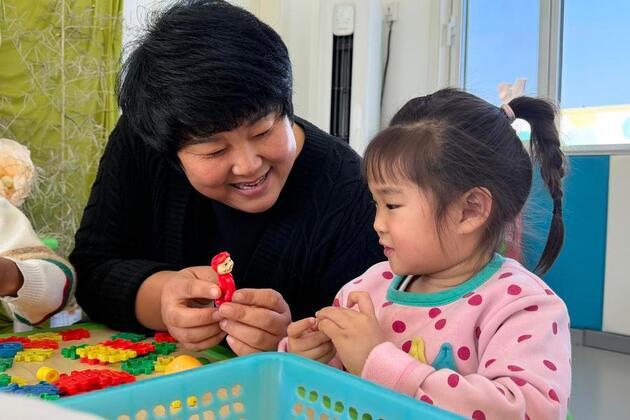
QINGDAO, Feb. 22 (Xinhua) -- In the sprawling tomato greenhouses of Cuijiaji town on the outskirts of Qingdao, a coastal city in east China's Shandong Province, farmers start working at daybreak. Some of them had by then already dropped off their toddlers at a vibrant, colorful daycare facility just a few steps away.
The wages of these rural workers, averaging 18 yuan (about 2.6 U.S. dollars) an hour, are more than sufficient to cover the basic monthly daycare fee at the Kangbei Childcare Center, which is the only nursery in the region that provides a 24/7 babysitting service. The daycare service costs 400 yuan a month, while full board is 10 times as much.
This facility provides a glimpse of a transformative model emerging in rural China that provides affordable, accessible and flexible childcare, which is adapted to the working hours of farmers, as opposed to the nine-to-five schedule more prevalent in urban areas.
The model also serves as an example of how Chinese society is working all-out to improve early childhood education by removing major obstacles such as high costs and scarcity of services, particularly for children under three years old. These children are considered too young for both kindergarten and preschool.
Dubbed "tomato town," Cuijiaji has more than 4,500 greenhouses that produce roughly 65 million kilograms of tomatoes a year. The industry has resulted in economic prosperity that draws many young people to work in these tomato fields.
BOTH HOME AND BUSINESS
Kangbei Childcare Center opened in Lyujia village of Cuijiaji town in October 2025, and is only 100 meters away from some of the greenhouses. Its name translates into healthy babies.
"It's a wish come true for young parents," said Sun Jie, mayor of Cuijiaji town. "Farmers follow the sunlight and the season. In summer, they start working at 5 a.m."
In the past, young farmers would either leave their children with grandparents or bring them along in strollers parked in the fields, which is hardly an ideal environment for early development.
Eyeing the needs of young parents, the local government invested 3 million yuan to renovate an old house into a nursery featuring 17 rooms and a playground. Its six teachers currently take care of 34 babies and toddlers.
This is the fourth rural childcare center managed by Zhu Xiuqin, a Cuijiaji native and single mother of two girls. These four centers accommodate 160 children in total, including eight full boarders from other provinces.
"We are different from traditional nurseries in many ways," Zhu said. "We don't hold parent-teacher meetings because the parents never have the time. Also, kindergartens in cities often feature bilingual teaching and even classes taught by native English speakers, but we instead focus on flexible drop-off and pick-up times, good care and togetherness."
Zhu, who previously ran a home furnishing business, spent most of her savings to open the first childcare center in 2018, hoping to provide a more stable environment for her own daughters. She used to leave the girls with a neighbor when she had to work. The childcare center was anything but lucrative, as a result of its low fees and high rental and labor costs. "I was not seeking to make a profit and was content to see my children being cared for and having friends."
Many villagers were ready to help, bringing bread, vegetables and meat to the childcare's kitchen. "It's like a home for everybody," Zhu noted.
GOVERNMENT SUPPORT
Zhu's efforts aligned with national and local policies promoting inclusive childcare.
In 2019, the Chinese government released a guideline urging the development of infant and childcare services, particularly for babies and toddlers under three years old. Local governments have since been urged to support childcare service providers with preferential policies covering land use, taxation and the recruitment of professionals.
"Young parents will be able to concentrate on their work when they know their children are under good care," said Dong Xinmin, a local village official. "Good childcare services will draw more young people to return home for work and thereby make their hometown a better place."
The city government of Qingdao supports the model by providing monthly subsidies for the second and third children of the same family enrolled in childcare centers. These efforts are aimed at easing families' financial burden and encouraging young couples to have more children.
Zhu has now given up her home furnishing business to concentrate fully on childcare. "Many children take me as their mom, and I am also attached to them."
In Yinjiang Tujia and Miao Autonomous County in China's southwestern Guizhou Province, meanwhile, 27 nurseries have been established via government and private funds, which accommodate 1,340 rural children under three years old.
"Each year we recruit about 15 children aged between two and three from all five villages in the area," said Xu Shun, principal of Tongxi Village School, which has dedicated a part of the school facilities and a special team of caregivers to bridging the gap for toddlers before they can enter kindergarten at the minimum age of three.
SUSTAINING THE FUTURE
Man Shuang, a graduate from Qingdao Technical College (QTC), works at Zhu's childcare center in Lyujia village. Born in 2005, she was trained to be a professional caregiver for babies and toddlers. "I love my job because I know I can make a difference," she said.
Institutes like QTC are key in sustaining this rural model of childcare, providing professional training for staff and sending students for internships. "The seemingly mundane daily routine of feeding, playing and napping is extraordinarily significant for the countryside," said Zhou Qi, a dean at the college. "It means stable growth for young lives and changes the traditional thinking that child-raising is just a family matter."
Experts say rural childcare services are crucial in supporting parents in the field, as China seeks to reverse its demographic decline and boost revitalization in the countryside.
China's total fertility rate has remained low for years, and its population, currently around 1.4 billion, has been in decline since 2022.
As Zhu Xiuqin puts it: "The children we nurture with love and professionalism today will become the resilient force supporting the development of the countryside tomorrow."



 Share
Share
 Tweet
Tweet
 Share
Share
 Flip
Flip
 Email
Email